
A Bad Hire Doesn’t Cost You a Salary. It Costs You a Year.
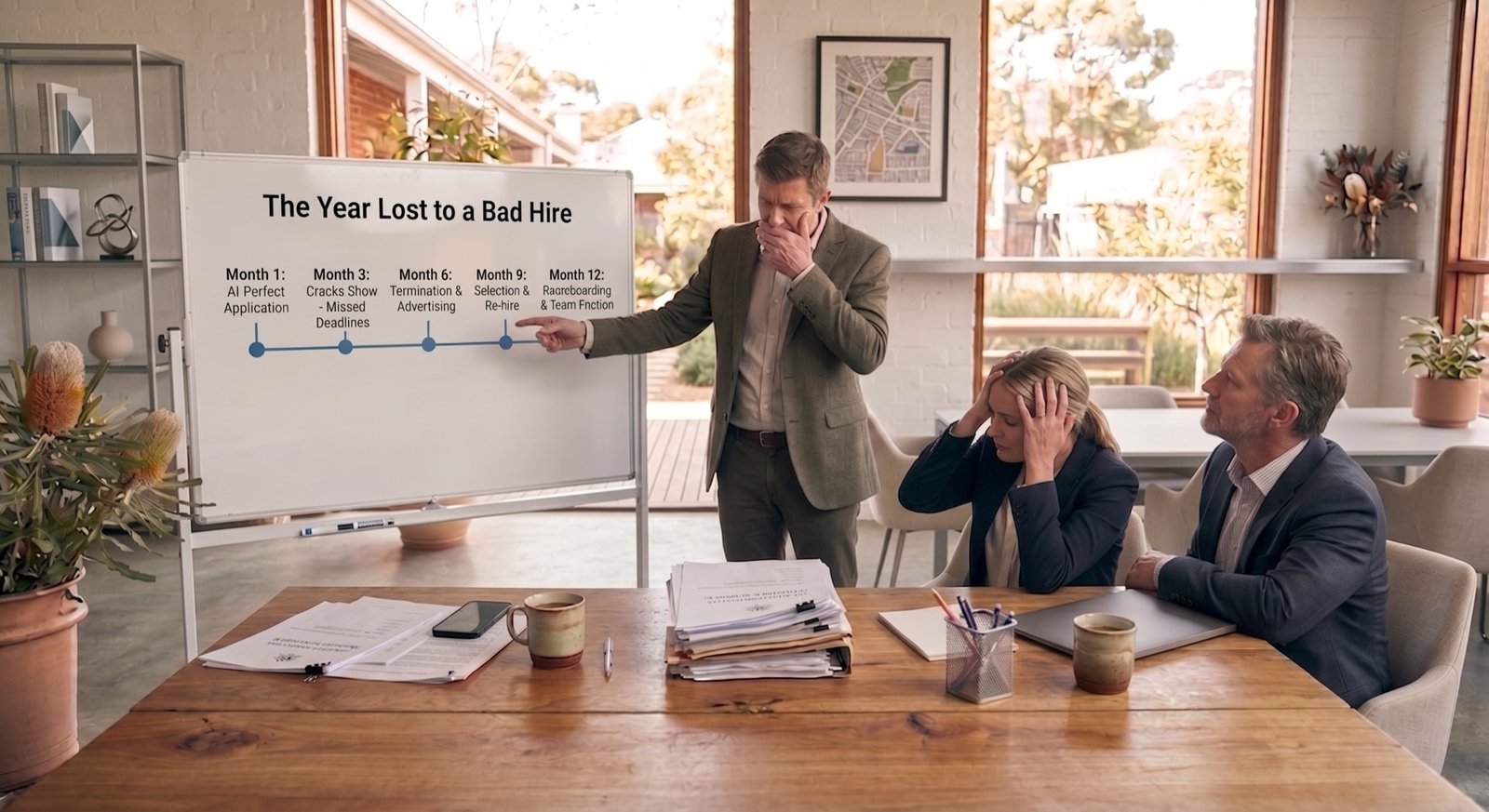
Picture a familiar scenario. A growing business needs an operations supervisor, urgently. The workload has been mounting for months, the owner is stretched thin, and a role has finally been approved. A candidate comes through with a strong resume and a great interview, confident, personable, said all the right things about “hitting the ground running.”
Three weeks in, cracks start to show. Deadlines are being missed. The candidate’s actual experience doesn’t quite match what came across in the interview. By week eight, two of the team’s best people are quietly frustrated, and one is actively looking elsewhere. By month four, the owner who was supposed to have this problem solved, is back in the middle of it, managing performance issues and smoothing over team tension on top of everything else they were already doing.
By month six, the hire doesn’t work out. Now there’s a termination process to manage, a role to re-advertise, and a team that’s noticeably more guarded about the next person who walks through the door.
It’s one of the most common patterns we see in growing SMEs and one of the most expensive.
What it actually costs
The salary is the smallest number on the page.
Australian research from Robert Half puts the direct cost of a bad hire at 15–21% of that employee’s salary as a baseline, and 86% of Australian business leaders say the impact of a bad hire is more severe today than it was even a year ago. Once you add in advertising and recruitment costs, onboarding and training time, lost productivity while the role underperforms, management time spent managing the problem, and the cost of doing the whole process again, broader Australian industry estimates put the real figure anywhere from 30% up to 150% of the role’s annual salary, higher again for senior or specialist positions.
Then there’s what’s harder to put a dollar figure on. The team members who quietly picked up the slack for months. The customer relationship that took a hit. The culture friction that lingers well after the person has gone. And the owner’s own time pulled straight back into the day-to-day business they were trying to build the capacity to step away from.
Add it up over the recruitment, the six months of managing it, the exit, and the re-hire, and it’s rarely a few weeks of disruption. It’s closer to a year.
Every candidate can look like the perfect fit now
Hiring well was never easy. It’s got harder in the last couple of years, for a reason most business owners haven’t clocked yet.
AI has made it simple for a candidate to produce a resume and cover letter that reads as a near-perfect match for your job ad, right keywords, right tone, right achievements framed in exactly the language you used to advertise the role. Research suggests the majority of job seekers now use generative AI tools somewhere in their application process, a figure that has climbed sharply in just a couple of years. That doesn’t automatically make someone a poor hire. But it does mean a polished application tells you far less about a candidate’s actual capability than it used to.
On top of that, some candidates are simply good talkers. They interview well, they’re likeable, they say the things a hiring manager wants to hear and none of that necessarily correlates with what they can actually deliver once they’re in the seat.
If your process still leans heavily on “the resume looked great” and “we had a really good chat,” you’re assessing presentation, not performance.
And then there’s the bias you don’t see
Even with the best intentions, most of us gravitate toward candidates who feel familiar, similar background, similar communication style, similar sense of humour, someone who “just gets it.” It’s a well-documented pattern known as similarity bias, and Australian research has found it’s the single biggest influence in a large majority of hiring decisions studied around 78% in one Australian survey of recruitment outcomes.
That instinct feels like good judgement in the room. It’s often just comfort, mistaken for competence. Left unchecked, it means businesses quietly hire versions of who’s already there, rather than who the role actually needs.
Polished applications, strong talkers, and our own unconscious pull toward people like us put those three together, and it’s easy to see why so many hiring decisions go wrong well before anyone signs a contract. Which is exactly why evidence of what a candidate has actually produced matters more now than ever. Not how they describe their work. What they’ve delivered, and what they can show for it.
Why we’re not a recruitment agency
Benchmark Talent Advisory’s Recruitment Advisory service exists because of this exact problem. We don’t place candidates and we don’t charge a placement fee, because our incentive isn’t to fill the role quickly. It’s to help you make the right decision.
That starts before anyone looks at a candidate. We work alongside you to build genuine role clarity, what this role actually needs to deliver, and what success looks like in your specific business context, then map the must-have skills, experience and behaviours that sit behind the job title. Everything downstream follows from that: a targeted sourcing and advertising approach built around the role’s real requirements, a consistent shortlisting framework so decisions aren’t made on gut feel, and a structured, evidence-based interview process designed to surface what a candidate has genuinely done not just how well they can talk about it.
We used this exact approach recently with a growing trades business we work with. When it came time to fill a key operations role, we didn’t start with job ads. We started by properly defining what the role needed to deliver in that business, then built a targeted advertising and screening approach around demonstrated, evidenced performance rather than a well-presented resume or a confident interview. The candidate they hired had the runs on the board to back up everything they said and the business avoided the costly cycle so many SMEs get stuck in.
Find the right person with the right process
If you’ve got a role open or one coming up, let’s get the role clarity right before you’re back in the market wondering what went wrong without the agency fees.
Book a discovery call with Benchmark Talent Advisory’s Recruitment Advisory team.
Written by Donna Benjamin, Practice Lead, Benchmark Talent Advisory, August 2026
Sources: Robert Half Australia, “The rising costs of a bad hire,” 2021 research release; industry analysis of Australian bad-hire cost benchmarks (2025–26); research on generative AI use in job applications (2024–2026 surveys); Diversity Australia survey on similarity bias in recruitment decisions. Client examples anonymised and de-identified.